I recently recorded an episode of Leadr. Podcast with a longevity doctor, and we spent an hour talking about aging.
Not the pop-science version. Not the “take this supplement and you’ll feel ten years younger” version. We talked about the actual research: what is happening at the cellular level, what is now being tested in humans, what we know about biological age, and how much of the aging process may be influenced by the way we live.
At some point during the conversation, I realised we weren’t really talking about aging. We were talking about work. More specifically, we were talking about the assumptions most of us have made about how long we can perform at a high level.
For most of our lives, we’ve been given a very simple model. You build your career, you get more experienced, you reach some version of your peak, and eventually your physical and cognitive capacity starts moving in the other direction.
The interesting thing happening in longevity science is that the model is becoming more nuanced and if the way we think about biological aging changes, the way we think about careers, leadership and what we’re capable of building over the long term has to change with it.
The Research Is Moving From Theory Into The Clinic
One development in particular caught my attention this year.
In January, the FDA cleared Life Biosciences‘ investigational new drug application for ER-100, a cellular-reprogramming therapy designed to test whether damaged cells in the optic nerve can be restored toward a more youthful state. The first participant was dosed in June, making this the first clinical trial of this type of partial cellular reprogramming in humans.
The trial is early. It is a Phase 1 study, and its primary purpose is to evaluate safety and tolerability. It is not proof that we’ve solved aging, and I don’t think we should pretend it is. But that isn’t what makes the development interesting to me. The important shift is that an idea that has largely lived in laboratories and animal research is now being tested in humans.
That’s a meaningful line to cross. For decades, aging was mostly treated as a constraint. You could influence some of the variables around it, but the underlying direction was assumed to be one-way.
The science is asking a more interesting question now: how much of biological aging is actually fixed?
We don’t know the full answer yet. But we know enough to start questioning the assumptions we’ve built around it and that has implications far beyond medicine.
We’ve Built Careers Around A Very Old Model Of Energy
Think about how most founders and executives approach their working lives.
There is a period where you’re building. You work hard, take on more responsibility, accumulate experience and eventually reach a point where you expect to slow down. Energy is treated almost like a bank account.
You have a certain amount. You spend it and recover. Then you do it again.
There is some truth in that model, but it misses a much bigger part of the picture. Your biological performance is influenced by the inputs you give the system.
Sleep affects cognitive performance and recovery. Exercise supports cardiovascular and brain health. Resistance training becomes increasingly important as we age. Nutrition affects metabolic health. Chronic stress has consequences that extend well beyond whether you feel tired at the end of the day.
None of this is particularly revolutionary.
What is changing is how precisely we’re able to measure these things and how much more we understand about the relationship between our biology and our performance. That changes the conversation.
Instead of asking, “How do I keep going for another twenty years?” a more interesting question is, “What would it look like to build the biological capacity to perform well for another twenty years?”
Those are two completely different approaches.
The Longevity Mindset Isn’t About Living Longer. It’s About Doing More With The Time You Have.
This was probably the biggest thing I took away from the conversation.
A lot of people approach longevity as protection. They track their sleep, take supplements, monitor their biomarkers. They exercise and experiment with different protocols. All with the underlying idea that they’re trying to prevent something from happening later.
I think there is a more useful way to look at it.
What if the goal isn’t simply to slow decline? What if it is to extend your period of high performance? That changes the mindset from preservation to capacity.
I’ve built my company around the idea that the right systems compound. A good process makes the next process easier. The right person creates leverage beyond their individual output. Technology can give a small team capabilities that previously required a much larger organisation.
Biology works in a surprisingly similar way.
The habits you build today don’t only affect how you feel today. They influence the capacity you have available to think, lead, create and recover over much longer periods of time. That’s why I care about this. Not because I want to spend my life optimising every biomarker. Because I want more good years in which I’m capable of doing meaningful things.
There is a difference.
I Started Looking At My Own Biology Differently
I started tracking my biological age about a year ago. Not obsessively. Intentionally. That experience is part of what led me to build the AIR Protocol. I wanted to take the things I was learning, biological age, performance, recovery, metabolic health and the fundamentals of longevity and turn them into something more practical and usable.
I wanted to understand the gap between chronological age and what the underlying health data was actually telling me. Some of the results were exactly what I expected. Some weren’t. But the most useful part wasn’t the number.
It was what happened to my decision-making once I had a baseline.
When you’re only paying attention to how you feel today, it is easy to miss patterns. You have a great day and assume it was random. You have a terrible day and blame the workload. Once you start collecting data, you can ask a better question. What do my best days have in common?
Maybe it’s the amount of sleep you had. Maybe it’s the type of training you did. Maybe it’s what you ate, how much time you spent outside, how much work you were carrying or whether you actually gave yourself enough recovery.
The point isn’t to become obsessed with tracking. The point is to become more informed about your own system.
That’s the part of longevity science I find most useful.
It gives you a framework for moving from assumption to observation.
Your Health Is Part Of Your Operating System

We talk constantly about the systems inside a company.
The CRM, financial model, hiring process, AI layer, the operating rhythm. We spend enormous amounts of time trying to make those systems perform better. But the person making the decisions is also a system.
Your brain, your energy, your sleep, your metabolic health, your stress response and your ability to recover all influence the quality of the decisions you make. That doesn’t mean every bad decision is a biological problem.
It means biology is part of the operating environment.
I’ve become much more interested in this idea as I’ve built companies because the highest-value work isn’t usually about doing more. It’s about thinking clearly. Making the right decision. Seeing the pattern before everyone else does. Having enough energy to stay curious. Being able to recover and come back with a fresh perspective.
If longevity science can help us understand how to preserve and improve those capabilities over longer periods, that’s not a wellness conversation.
That’s a leadership conversation.
The Goal Isn’t To Optimize Everything
This is where I think the longevity world can sometimes become unnecessarily complicated.
There will always be another test, another supplement, protocol, wearable or number you can track.
I’m interested in the science, but I’m not interested in turning life into a spreadsheet. The fundamentals still matter.
Sleep quality matters. Regular movement matters. Cardiovascular fitness matters. Strength matters. Nutrition matters. Recovery matters. Managing chronic stress matters.
Those aren’t exciting because they’re new. They’re exciting because they compound.
The more advanced research is fascinating too. Biological age testing, metabolic monitoring and cellular reprogramming are all areas I’m watching closely because they give us a better understanding of what might eventually be possible.
But I don’t think we need to wait for a breakthrough therapy to start taking our future capacity seriously.
The opportunity is already here. Start with the things we understand. Then keep learning as the science moves forward.
This Changes How I Think About The Second Half Of A Career
One of the biggest assumptions I’ve started questioning is the idea that the best years of your career have to happen early.
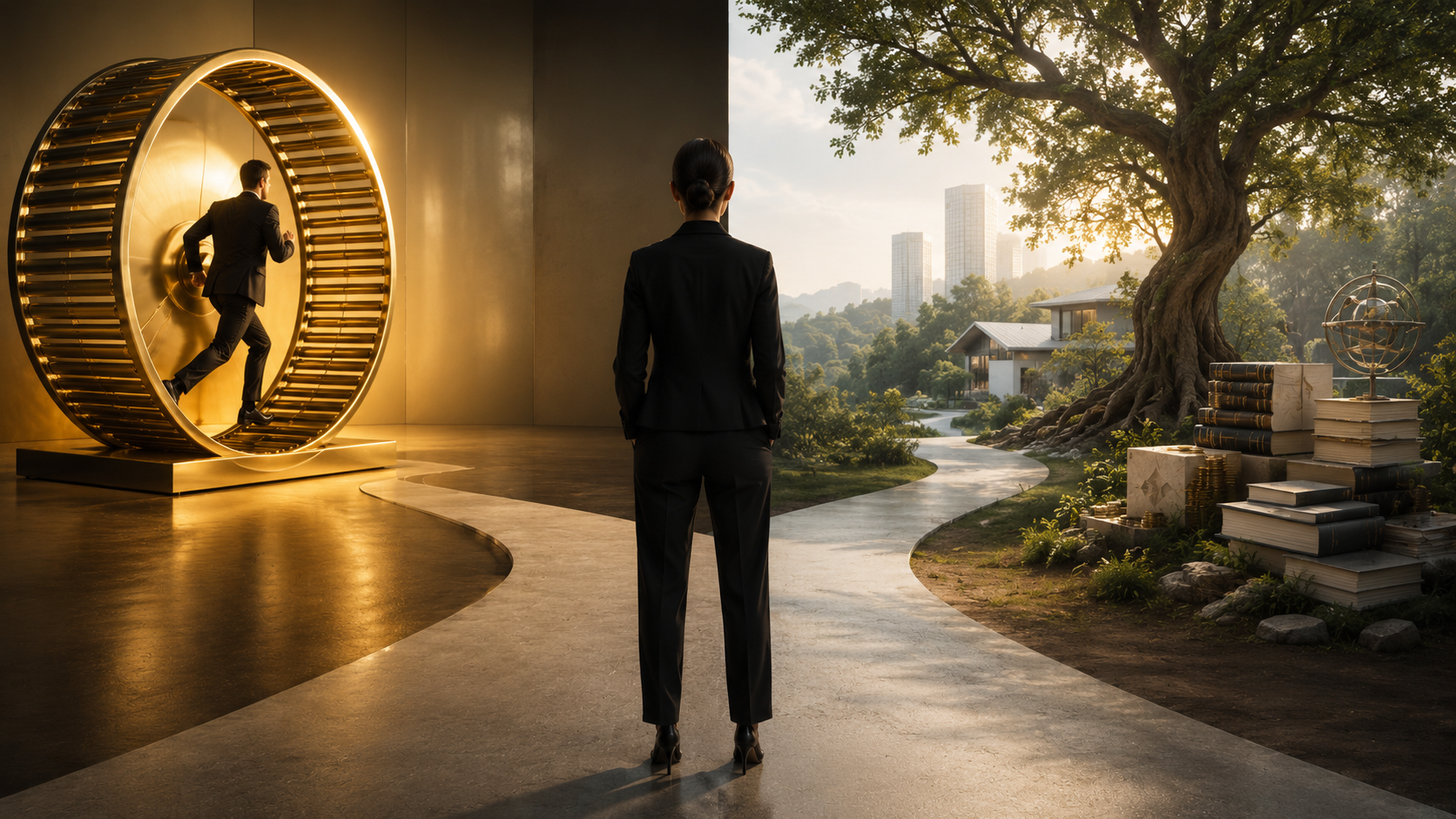
We’re used to thinking about careers as a climb. You build experience through your thirties and forties, reach some version of your peak, and then gradually step back.
But what happens if the period of high performance can be extended? What happens if better health, better technology and better systems allow someone to keep building at a high level for much longer?
You don’t necessarily have to think about your career as a race toward a finish line. You can think about it as compounding. More experience. Better judgment. Stronger relationships. More capital. Better technology. And, ideally, a body and mind that are still capable of supporting the work.
That’s a very different vision of the future. It also makes the decisions we make today much more interesting. Because the goal isn’t just to build something successful now.
It’s to build a life and a business that you are still excited and capable of participating in years from now.
This Is Why I Keep Bringing Longevity To Leadr.
When I started Leadr, I wanted to have conversations about the whole human behind the company.
Not just strategy, tactics, revenue, growth or performance.
I wanted to explore the intersection between how we operate mentally, physically and spiritually and how that ultimately shows up in the companies we build and the lives we create.
Longevity keeps coming back into that conversation because the science is becoming harder to ignore.
The FDA clearance for the ER-100 trial is one example. The growing ability to measure biological age is another. The research connecting sleep, exercise, metabolic health and cognitive performance gives us another piece of the picture.
None of this means we have all the answers. That’s actually what makes it interesting. We’re learning in real time. And I think there is something powerful about building your career the same way.
Stay curious. Pay attention to the data. Question assumptions. Build systems that compound. And leave enough room to change your mind when better information arrives.
The old model says your performance has a peak, and eventually you move away from it.
The emerging model is more interesting.
Maybe the goal isn’t to peak once. Maybe it’s to keep expanding what you’re capable of for as long as you can.
That’s the idea I’m taking into the next stage of my own work. Not trying to work forever. Trying to make the years I have count for more. And if the science is right about even part of what may be possible, we may have a lot more time to do exactly that.
That’s a future worth building for.



















Read the Comments +