

Claude Cowork launched 60 days ago. Gemini has Project Mariner. Manus just got acquired by Meta for $2 billion. Here’s what none of the hype actually tells you.
I’ve been watching AI demos for three years. I know the formula by now.
Clean desktop. Perfectly formed prompt. The AI does something impressive. Applause. Cut.
Then you try it on a real Tuesday morning, with your actual files and your actual calendar, and it falls apart at step three.
Something is different about what’s happening right now. Not because the models got smarter, they did, but that’s not the point. The point is that AI finally stopped giving you advice and started doing the work.
That shift is what this article is actually about.
The Thing That Changed
For the past three years, every AI tool operated the same way. You typed. It responded. You took what it gave you, copied it somewhere, implemented it yourself, and repeated the loop. The AI was a brilliant colleague who never picked up the phone, only texted back suggestions.
What’s emerging in early 2026 is a category shift. These new tools , Claude Cowork, Google’s Project Mariner, Manus (now inside Meta), Perplexity Computer, don’t respond to you. They work for you. You describe an outcome. They plan it, execute it across multiple steps, use your actual files, browse the actual web, and hand you a finished deliverable.
The gap between those two things is enormous. It’s the difference between a consultant who emails you a strategy deck and an employee who executes the strategy.
Claude Cowork: The Brilliant Librarian

Anthropic launched Cowork in January 2026 as a research preview. It was built in roughly ten days , mostly by Claude Code, its developer-facing sibling and the origin story tells you everything about the philosophy behind it.
Cowork lives inside the Claude Desktop app. It runs in an isolated virtual machine on your actual computer. You grant it access to specific folders, connect it to your calendar, Slack, Gmail, Google Drive, or any of 50+ integrations — and then you describe an outcome.
Not a prompt. An outcome.
“Pull every external meeting from my calendar next week. Research each attendee and their company. Flag anyone who could be a client. Deliver a brief to my Slack channel by Sunday night.” That’s a single instruction. Cowork breaks it into subtasks, dispatches parallel sub-agents to handle them simultaneously, and comes back with a finished document.
Where Cowork genuinely excels: document-heavy work. It reads your files directly — no uploading, no copy-pasting. It produces real Excel spreadsheets with working formulas, formatted Word documents, PowerPoint decks. It handles massive context. Researchers have fed it thousands of rows of data and it doesn’t skim — it reads everything. For knowledge workers whose days are spent inside documents, this is the unlocking moment.
Where it shows its limits: the open web. One sharp analyst described it well, Cowork is like a brilliant librarian who is occasionally afraid to leave the library. Its web browsing runs through a Chrome extension that can struggle with complex or JavaScript-heavy sites. If your work lives primarily in documents and your own file system, this barely matters. If you need a native web scraper, look elsewhere.
One more thing worth saying clearly: your data stays local. The VM runs on your machine. This matters if you work with client information under NDA, with healthcare data, or with anything you’d rather not route through a third-party cloud.
Manus: The Digital Intern Meta Just Acquired

Before Anthropic launched Cowork, Manus was the tool that made AI agents feel real to a lot of people. It’s a cloud-based agent — meaning it doesn’t live on your machine, it runs in Meta’s infrastructure — and its native element is the open web.
Manus opens browsers, navigates pages, clicks buttons, extracts data, and delivers finished files. Give it a goal that requires gathering information from across the internet and it often delivers something impressive. For non-technical users who need a digital intern for web-based research, lead generation, or data gathering without a $200/month barrier, Manus has been the accessible entry point.
Meta acquired the core architecture in December 2025. The integration roadmap points toward Ads Manager, WhatsApp, and Telegram — which means Manus’s real play is mass-market distribution, not enterprise depth. Four million advertisers already inside Ads Manager is a different kind of moat than any technical benchmark.
The honest trade-off: Manus is credit-hungry and cloud-dependent, which means your data flows through Meta’s servers. For personal projects and general research, that’s probably fine. For anyone handling sensitive client data — say, a MedTech consultancy working under NDA — that’s a procurement conversation you’d want to have before you start.
There’s also a regulatory overhang: the Chinese government is still reviewing the acquisition under technology export and national security rules as of March 2026. Enterprise teams evaluating Manus for longer-term workflow integration should factor in that uncertainty.
Google’s Project Mariner: The One to Watch
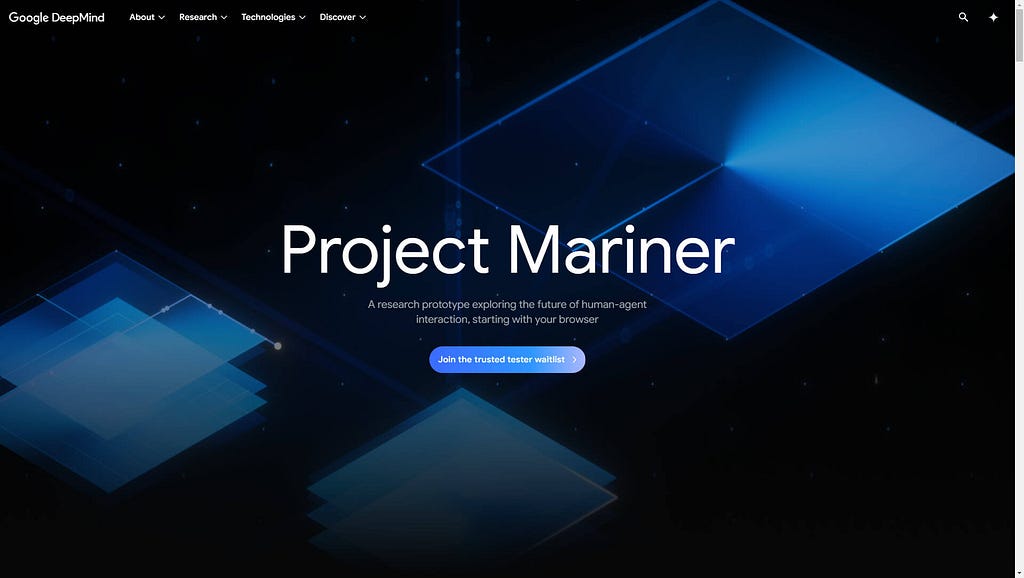
Google’s agent play is called Project Mariner, and it’s still in limited preview, which is exactly why it belongs in this conversation.
Mariner is built on Gemini and deeply embedded in Google’s ecosystem. Gmail, Calendar, Drive, these aren’t integrations Mariner connects to through a third-party protocol. They’re native. If your entire work life runs through Google Workspace, Mariner’s integration advantage is real in a way that other tools have to work around.
The vision is parallel task execution, Mariner running multiple complex tasks simultaneously while learning from how you work. The ambition is an agent that doesn’t just execute instructions but adapts to your patterns over time.
The honest caveat: it’s not generally available yet. What Google is promising and what’s shipping today are still some distance apart. But if you are a Google-native knowledge worker and a huge percentage of the professional world is, Mariner is worth watching closely. Google’s distribution advantage means that when this ships broadly, adoption won’t require convincing anyone to download a new app.
Perplexity Computer: The Research Specialist

Perplexity’s entry is different from all of the above. Computer is a cloud orchestrator that routes your task across 19 different AI models, Claude Opus for deep reasoning, Gemini for research, specialized models for specific outputs and coordinates them in the background while you do other things.
The philosophy is interesting: the best AI work requires multiple specialized models working in concert, not one model doing everything adequately. Close your browser. Come back later. The work continued without you.
The trade-off is cost, it’s the most expensive option in this space and it’s best suited for deep research projects rather than day-to-day operational work. If you’re running strategic competitive analysis or synthesizing large bodies of research, it’s compelling. For recurring workflows and document work, Cowork is more practical.
How to Actually Think About This
The coverage of these tools tends to frame it as a horse race. Which one wins? Which one should you pick? That framing is wrong.
These tools are specializing, not converging. Cowork is becoming the default for local file-heavy knowledge work, the kind of work that lives in documents, contracts, decks, and spreadsheets. Manus is becoming the default for mass-market web execution. Perplexity Computer is becoming the default for research-intensive projects. Mariner will become the default for Google-native teams the moment it’s widely available.
The more useful question isn’t which tool wins. It’s which one matches the actual shape of your work.
If your work lives in documents, client files, and multi-step deliverables and especially if you’re working with information that shouldn’t leave your machine, Cowork is where to start. If you need a web-native agent that can gather intelligence from across the internet and doesn’t require a desktop app, Manus fills that gap right now. If you run deep strategic research and the cost is a rounding error, Perplexity is worth evaluating. If your team lives in Google Workspace and you can wait, Mariner is the one to pilot when it ships.
The Real Shift Isn’t the Technology
The head of Microsoft AI said recently that human-level performance on most professional tasks, law, accounting, marketing, is about 12 to 18 months away. Based on what’s already shipping, that timeline feels right.
That’s not a comfortable thing to sit with. But the professionals I’ve watched thrive in this environment aren’t the ones trying to out-compete the tools. They’re the ones who figured out how to direct them. The strategy. The judgment. The knowing what to build and why.
AI stopped answering questions and started doing work. The gap between knowledge workers who know how to direct that and those who don’t, is widening fast.
The window to get on the right side of that gap is still open. It won’t be forever.













Read the Comments +