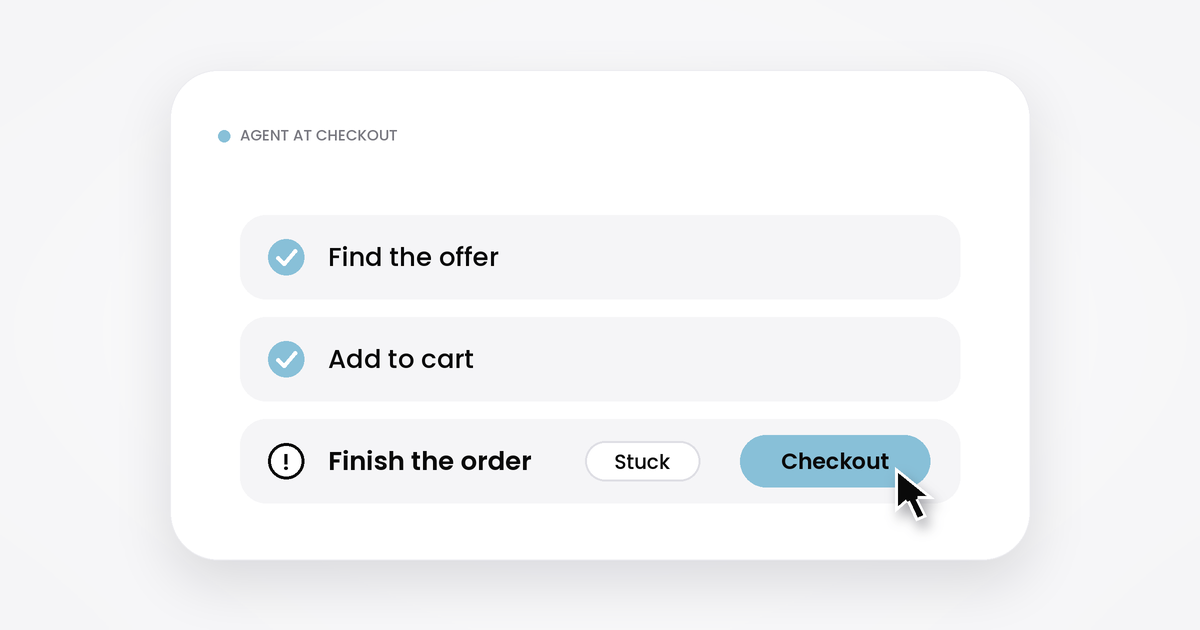
Spoiler: Your checkout page was built for people, and an AI agent might discover that before you do.
Last week, two of the biggest retailers in the country took very different approaches to the same question: should an AI agent be allowed to shop on a customer’s behalf?
On 21 October, Walmart announced its Agent Gateway, a new way for approved AI agents to connect with Walmart and Sam’s Club to shop for customers. The announcement came shortly after Amazon began blocking third-party AI agents from making purchases on its platform, according to TechCrunch.
The contrast is hard to ignore. One retailer is building a way for agents to shop more reliably. The other is restricting their access.
And it raises a question for every business with a website: if an AI agent tried to buy from you today, would it make it to checkout?
I’d bet many websites aren’t ready.
Pick a Door
Walmart’s announcement is worth reading because it’s practical. Its plans include dedicated profiles for AI agents, giving customers a way to distinguish agent purchases from their own. Customers will be able to require approval for every purchase or set spending limits, and they can revoke an agent’s access when they choose.
Walmart has also outlined safeguards around payment information, customer permissions and returns. Its Agent Gateway is designed to give approved agents a faster, more reliable way to shop than navigating a website built for people. The company says it will begin with a beta for companies and developers, while Agent Profiles are expected to launch separately.
Amazon has taken a different approach. TechCrunch reported that the company had begun blocking third-party agents from making purchases on its platform. The same report describes travel and booking websites that have also restricted agent access.
Neither approach is automatically wrong.
A business that wants to retain control over every step of the customer relationship may have good reasons to restrict third-party agents. A business that wants to meet customers wherever they choose to shop may have good reasons to make agent access easier.
The important thing is to make that choice deliberately.
What concerns me is the third group: businesses that haven’t decided at all. They’re still making a choice, because whatever their website does when an agent arrives becomes the practical policy, whether anyone has thought about it or not.
Where Agents Get Stuck
Walmart has acknowledged a problem that goes beyond its own business. In its announcement, the company explained that agents currently navigate websites through browsers, following steps designed for people. That process can be slow and error-prone, and agents can get stuck along the way.
That’s Walmart describing the limitations of the traditional browsing experience. Now think about your own website.
Pop-ups that interrupt the journey. Forced account creation before a customer can proceed. Booking calendars that load slowly. Forms that end with “someone will be in touch”. Prices that only appear after someone clicks a contact button.
These are examples of friction that can make a customer journey harder to complete. An AI agent may struggle with the same obstacles, particularly when a step requires a person to interpret something, make an unexpected choice or intervene manually.
The difference is that a human customer may persevere, find a workaround or contact your team. An agent may simply fail to complete the task.
And unless you’re monitoring the journey, you might never know why the opportunity disappeared.

Founders and CEOs spend a lot of energy thinking about how customers find them. I think there’s another question worth asking: can a customer’s assistant finish the job once it arrives?
Your website is already making a decision about agents, whether you’ve made one or not.
The Five-Minute Test
You don’t need to start with an expensive technical project to get a first indication of how your website handles an AI-assisted customer journey.
Start with a simple test.
Open ChatGPT or Claude, use the available browsing capabilities, and try a prompt like this:
Go to [your website]. Pretend you’re a customer who wants to buy or book [your offer]. Get as far as you can, but stop before entering any payment details or submitting anything that creates a real commitment. Then tell me every point where you got confused, blocked or had to guess.
The aim isn’t to prove that your website is fully compatible with every AI agent. A single test cannot establish that. It’s to identify potential friction in the journey and understand where further investigation might be worthwhile.
Read the result like a list of potential customer-experience problems.
Could the agent find the right product or service? Were the prices and terms clear? Could it understand the next step? Did it encounter a sign-in requirement, a confusing form or a page it couldn’t navigate?
Fix the most important issue first, then repeat the test using another tool. Different agents can behave differently, so one successful attempt doesn’t guarantee that every agent will have the same experience.
And remember: a browsing test is a starting point, not a technical audit. It won’t necessarily tell you whether your website permits automated access, whether your security settings will block other agents or whether a complete transaction could be carried out reliably.
Then comes the part only you can decide.
Do you actually want AI agents to complete purchases or bookings on behalf of your customers?
If the answer is yes, investigate how to make that journey clearer and more reliable. If the answer is no, that’s a legitimate business decision too. You may have commercial, security or customer-experience reasons to restrict agent access.
The point is to make the decision intentionally, rather than letting an accidental technical barrier make it for you.
Decide Before Your Customers Do
The contrast between Walmart and Amazon isn’t simply a story about which retailer is more enthusiastic about AI. It’s a reminder that businesses are beginning to make different choices about who, or what, they’re willing to serve through their digital channels.
For some companies, allowing third-party agents to shop may create a more convenient route to purchase. For others, restricting access may be the right choice for now.
But ignoring the question won’t make it go away.
You don’t need to rebuild your website this week, adopt every new AI tool or assume that all your customers will soon be using agents. You do need to understand how your current customer journey works, where it creates friction and what you want an AI-assisted interaction to look like.
So here’s what I’d leave you with.
If an agent showed up at your checkout this afternoon, would it make it through? Would you want it to? And if you don’t know yet, what’s stopping you from finding out in the next five minutes?
Your next customer may never visit your website themselves. The assistant they send in their place will encounter your website exactly as it finds it.





























Read the Comments +